|
Other Historic Sites in or near North Collins First Congregational Church There is a marker at the site of the original church and cemetery at the intersection of Route 62 (Main Street) and School St. in front of the current Congregational Church. The first congregation was organized in 1818. School St. was named Church Street at that time. The Methodist Episcopal Church was situated immediately north of the Congregational Church. The shared cemetery was located near the road in front of the Congregational Church. Most of the remains interred there were later transferred to North Collins Cemetery. Haberer House Hotel This marker is located on the south wall of the hotel (now North Collins Hotel) at the intersection of Sherman and Railroad Avenues in the Village of North Collins. It was built after the railroad came through and was once known as a honeymoon hotel. The first floor housed the dining room and bar. The second floor was rooms for rent. The third floor was a large hall for community use which saw church services (before the churches were built), graduations, wedding receptions, plays, dances, and other social events. Hicksite Quaker Meeting House
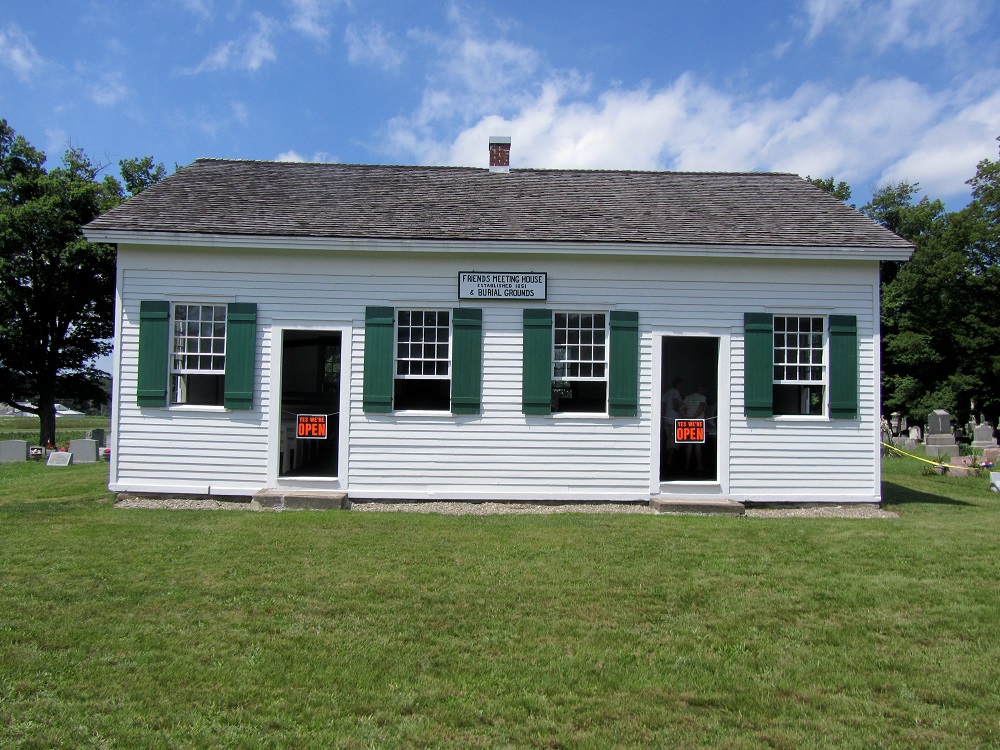
The Hicksite Quaker Meeting House is located in the front of the North Collins Cemetery on Route 62. The first
meeting house was built there in 1832 following the split of the Orthodox
and Hicksite Quakers. The existing meeting house was built in 1851 to
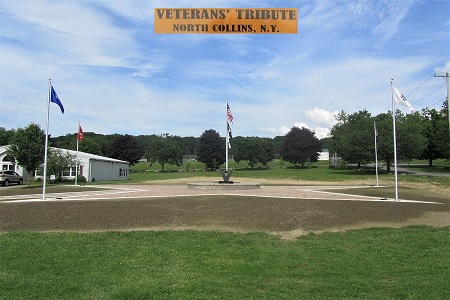
replace the original structure. In 2012-2013 the Hicksite Quaker Meeting House was restored and opened as a Quaker Meeting House Museum on July 14, 2013. (See "North Collins Historical Society" below) Enos Hibbard Estate The large brick home located at the intersection of Route 62 and Center Street in the Village of North Collins was built by Enos Hibbard when he married after his return from the Civil War. The brick building immediately west of the house is the brick carriage house of the estate. A marker is on the wall of the brick carriage house, now with a door and porch on Center Street. It was converted to North Collins Memorial Library in 1921 when the marker dedicating it to the memory of veterans was installed. The Women’s Relief Corps. (auxiliary of the G.A.R.) used the second floor for meetings and their historical collection. It later became the home of North Collins Historical Society. Today the building houses North Collins Historical Society exhibit room/museum on the main floor and their storage space on the second floor. The area where the bank parking lot is now located was once the orchard of the Hibbard Estate. It later was the home of the G.A.R. log cabin meeting house. North Collins Historical Society North Collins Historical Society Museum is located at 2021 Center Street in the Village of North Collins immediately east of the Hibbard Estate in its former carriage house. Open hours are from 1:00 to 3:30 p.m. the fourth Sunday of each month September through April, and the first and third Sundays each month from mid-May through September. All hours are from 1:00 to 3:30 p.m. The building is open by appointment by calling the Town Clerk’s Office at 337-3391 for information. Topical exhibits are changed once or twice per year depending on popularity and include documents and artifacts from the early era of the town and village to the present. Website at http://northcollinsny.org/html/histsoc.html. Special programs are held in conjunction with the topical exhibits. North Collins Historical Society also operates the 1851 Hicksite Quaker Meeting House located at the front of the south section of North Collins Cemetery on Route 62 about a mile south of the Village of North Collins. The 1851 Hicksite Quaker Meeting House will be open the 2nd and 4th Sundays of each month from mid-May through mid-September from 1:00 to 3:30 p.m. The Round Barn This barn is located at the north side at the top of the hill from Route 62 on Shirley Road. Although it appears round, it actually has 16 sides. As with all of North Collins, the land on which it is built was originally purchased from the Holland Land Company. It was built approximately 1900 as working dairy barn. At the time this was considered the most efficient barn since hay and grain were brought down in the center of the barn for distribution to the cattle in stanchions almost all the way around. There was a separate box stall for horses and another small room for their harnesses as well as a small space for farm tools pulled by the horses. Veterans Tribute Unveiled June 15, 2019, the Veterans Tribute honors the men & women who have served in the Armed Forces during war and in peacetime. The complex is designed in the shape of a huge five-point star, with each point on the star featuring the flag of a U.S. military branch (Army, Navy, Marines, Air Force, and Coast Guard). In the center, the U.S. flag flies above the Victory monument, which boasts a giant "V". The Veterans Tribute is located at the North Collins Town Park.
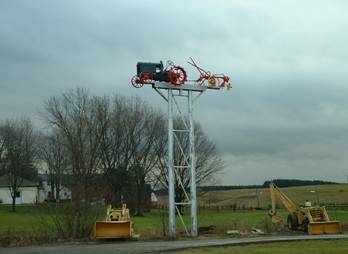
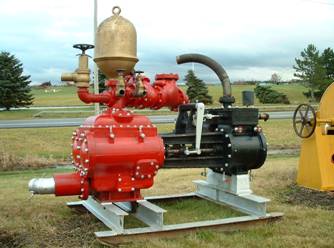
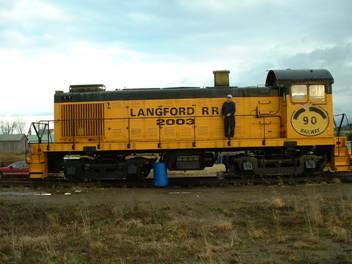
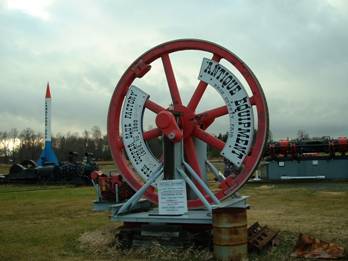
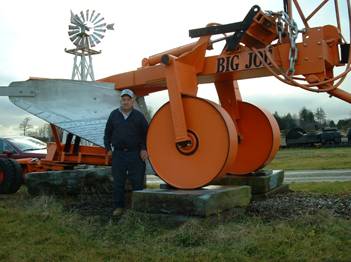
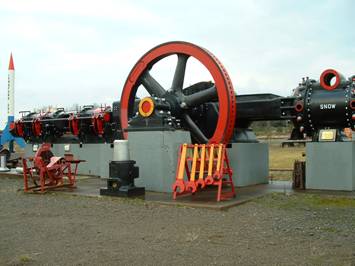
Sweet Family Cemetery This is typical of many small family cemetery plots scattered among the farms of the settlement period prior to the incorporation of cemeteries. Most of these no longer have visible stones to mark the spots where family members were interred. The Sweet Family Cemetery is located in a woods near the top of a hill on east side of New Oregon Road about a mile north of the intersection with Langford Road. Perhaps the trees have protected the stones so they remain in reasonable condition. Wilcox Quaker Cemetery This small cemetery is located at the northwest corner of the intersection of Quaker and Wilcox Roads. It originally belonged to the first known Quaker Meeting House in North Collins. It burned in the early 1900s and was never replaced. Now largely overgrown, it contains the graves of three Revolutionary War soldiers. This is unusual for a Quaker Cemetery since Quakers were probably the original conscientious objectors. Their faith did not allow participation in a war. Hamlet of Langford This is centered around the intersection of Langford Road and Route 75 (Sisson Highway). The buildings at the intersection are largely the original buildings from the mid-1800s. The building on the northeast corner originally contained a hotel facing Sisson Highway with a post office near the rear of the building facing Langford Road. A wooden porch/sidewalk extended along both sides of the building. The southeast corner housed a smaller general store and saloon. The southwest corner housed another saloon and living space. A brewery was built somewhat further south. Its foundation after the brewery went out of business was later used as the foundation for St. Martin’s R.C. Church. The first church picnic-dinner/fair was held in the orchard behind the hotel. Once begun, the reputation of the church dinners for excellent home-cooked food and dessert grew rapidly, expanding attendance each year since. In 2006, St. Martin’s R.C. Church merged with St. Mary's R.C. Church from New Oregon, along with St. Francis Cabrini R.C. Church in Collins Center, and was renamed Epiphany of Our Lord Parish. The newly-formed congregation is based at the Langford location. Hamlet of Lawton’s Station The hamlet was so named because its earliest settlers belonged to the Lawton family. The “station” portion of the name became popular after the railroad came through in 1872. Its Main Street, part of the intersection of Marshfield Road/Main Street and Route 62, was first done as a private street. Lawtons, as the hamlet is now known, is the only area in the Town of North Collins, outside the Village of North Collins, with its own water and sewer service. The original schoolhouse for this hamlet was located on Reservation Road, believed to be the current Seneca Street. It later moved to a site on the east side of Route 62 north of the intersection. Hamlet of Marshfield This hamlet, south of the hamlet of Langford, was a flourishing area at the intersection of Marshfield Road and Route 75 (Sisson Highway) in the mid-1800s with no fewer than three churches. Schoolhouse #10 was just east of the intersection on the south side of Marshfield Road almost across the street from the Methodist Episcopal Church on the northeast corner with its own small cemetery. Only a few stones remain today, mostly lying on the ground. There was also a Baptist Church on Sisson Highway south of the intersection on land only loaned temporarily for a number of years. There is also another unidentified church. Marshfield Burying Ground, a fairly large cemetery in use until the early 1900s, is located on the hill just south of the intersection on the east side of the road. Today it is among trees and one must walk up the hill on a farm road. Among the numerous homes on all sides of the intersection was a cheese factory on Sisson Highway just south of the churches. Hamlet of New Oregon This hamlet is centered around the intersection of New Oregon and Langford Roads. For many years, St. Mary’s R.C. Church -- consisting of a church building from the mid-1800s, as well as a school and rectory -- occupied the southwest corner. A merger with St. Martin's R.C. Church in Langford in 2006 necessitated sale of the St. Mary's property, which has been converted for use as a bed & beakfast. The north corners were originally small businesses. Dankner Town Park now occupies the northeast corner which was undeveloped previously. A general store originally occupied the southeast corner in the mid-1800s and just south on that side were the blacksmith shop, sawmill, and homes. The building at the corner is now a restaurant/bar. South of the intersection on the west side of the road was Schoolhouse #12, the post office, a dance hall, and more homes for the earliest settlers. Hamlet of Shirley There is a marker is on Angling Road immediately north of the intersection of Shirley Road and Angling/Quaker Roads. It was the heart of North Collins until the railroad came through Kerr’s Corners (now the Village of North Collins) in 1872. The business center then shifted to that area because of personal and business opportunities. All that remains of the bustling hamlet is the stone foundation of a mill and other small buildings along the creek. Abram Tucker Settlement Area This marker is located on the west side of Route 62 somewhat south of Milestrip Rd. It is the site where Abram Tucker and other early settlers built their log cabins c. 1809. Folklore says that the original log cabin at the site used a huge tree stump for its table. The cabin was said to have been built around the stump. Nothing remains of their occupation of the area at this time. Ed Winter’s Antique Industrial & Farm Equipment Display Located on Route 75 (Sisson Highway) in Langford (Ten miles south of Hamburg on Route 75), this display has antique equipment such as:
- 100 ton Engine manufactured in 1914 by Snow Equipment Company - 70 ton flywheel from Bethlehem Steel plant in Lackawanna - 1938 Worthington Engine/Compressor - Farm plow that plows 5 feet deep - 1928 Rumley Oil Pull tractors - 1,000 horsepower locomotive on track - 12” gauge steam locomotive - Two steam powered farm tractors: 1) Case 2) Buffalo Pitts (one of three in the world)
|
|
|